
When a parent starts to decline, nobody hands the family a map
Your parent is aging. Nobody handed you the manual. This is the manual.
The plain-English guide to the first 90 days — mapped.

Exactly what you get
The Core Guide51 pages · 14 chapters · the four fronts · 90 days
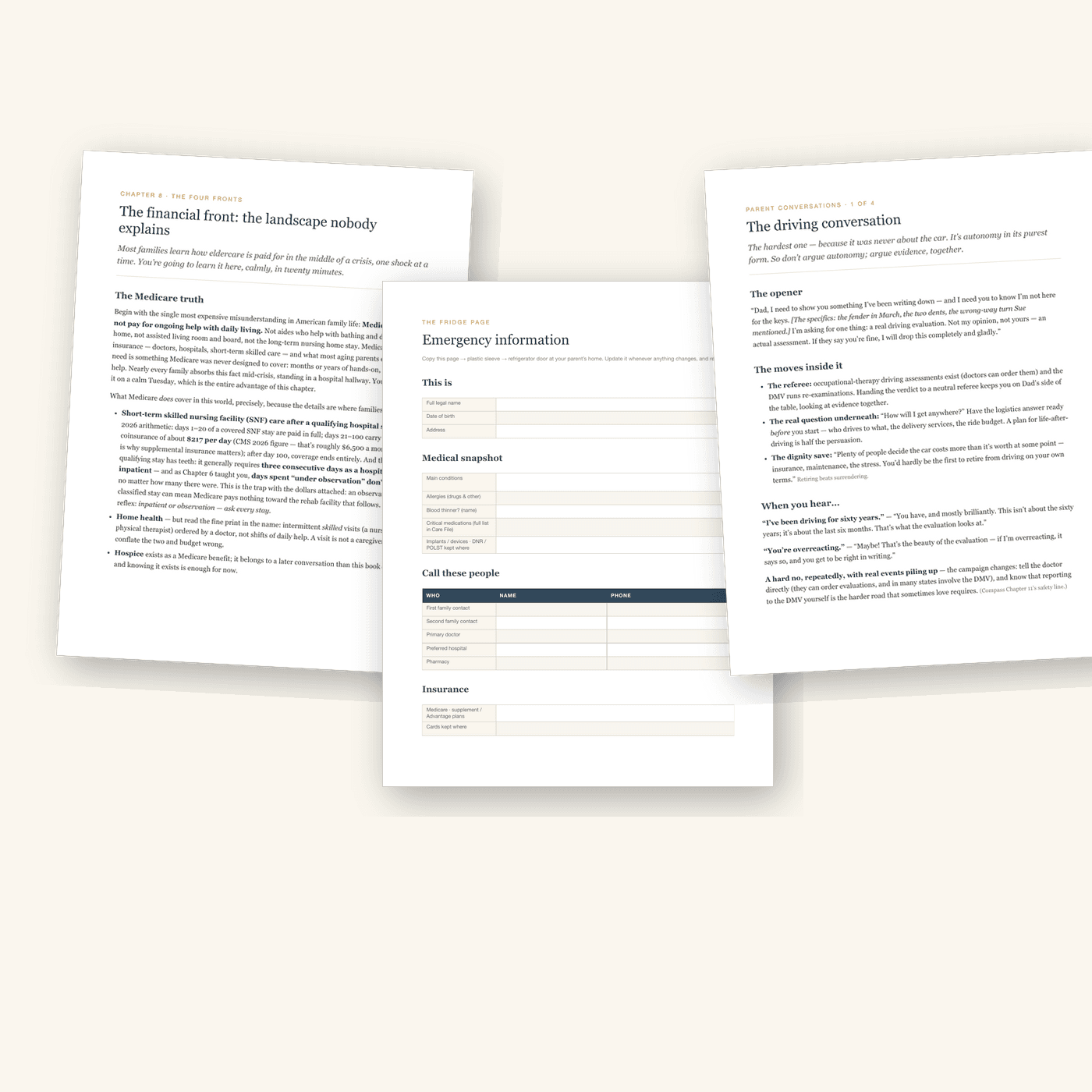
- What’s actually happening medically — dementia, stroke, Parkinson’s, frailty, in plain English
- The legal window, the Medicare truth, and what care actually costs (2025 medians, sourced)
- The family meeting, the sibling scripts, and the hard conversations
- The professional help most families never find — with the phone numbers
- Every claim sourced: NIA, the Alzheimer’s Association, AARP research, CMS, CDC
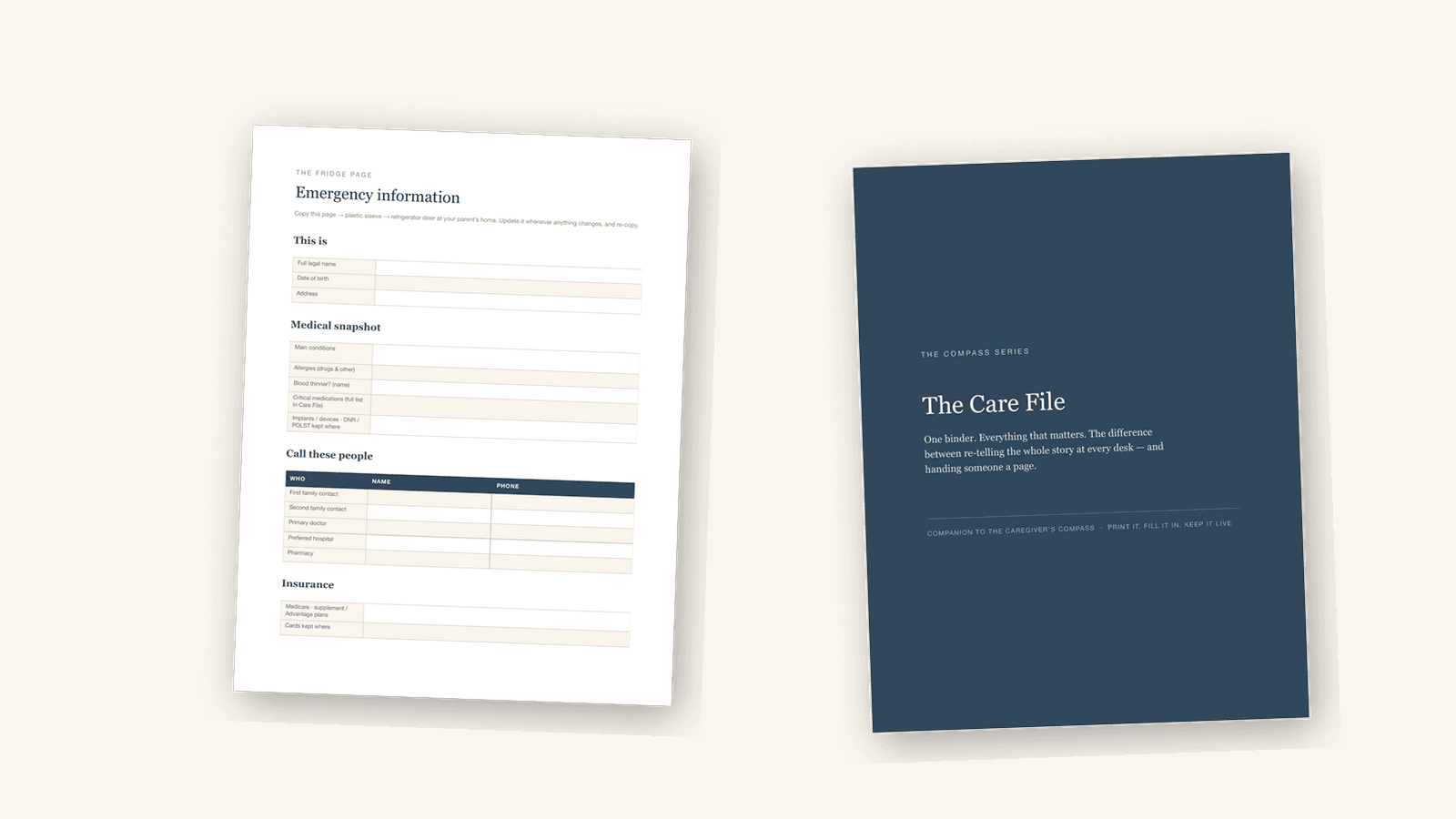
The Care File17 pages · printable · the master binder
- The emergency page that lives on the fridge — EMTs are trained to look
- The medication list every ER asks for first
- Insurance, legal-document, and provider inventories on ready-made forms
- The events log that turns scattered worry into a trend a doctor can act on
The Appointment Playbook12 pages · scripts & question banks
- Being taken seriously in the caregiver’s seat — the exact scripts
- Question banks for the neurologist, geriatrician, and rehab team
- The hospital playbook — including the observation-status question that can determine what Medicare pays
- The facility-tour question bank that sees past the chandelier
The Conversation Playbook10 pages · the words for the hard talks
- The driving, money, help, and moving conversations — openers and comebacks
- The sibling scripts: the enlistment, the critic, the ghost
- The family-meeting kit: invitation, agenda, notes, the monthly email
Four PDFs (five with “The Paperwork Reset”) · instant download · yours forever · start the Care File tonight.
An elder-law attorney runs $300+ an hour. A geriatric care manager's assessment can run $1,500. This is the preparation layer that makes every professional hour — and every fifteen-minute appointment — actually count.
- The Core Guide — the first 90 days mapped: the four fronts (medical, legal, financial, living situation) and the system that replaces 2 a.m. panic
- The Care File — the master binder: the emergency fridge page, medication list, insurance and legal inventories, and the events log
- The Appointment Playbook — scripts for the caregiver's seat: doctors, hospitals, discharge planners, facility tours
- The Conversation Playbook — the words for the keys, the money, the help, the move — plus the sibling scripts and family-meeting kit
4 PDFs · 51-page core guide · 17-page Care File binder · scripts for the four hardest conversations
30-day money-back guarantee — full refund, keep the Care File.
Secure checkout by Shopify · Published by The Reset Series · Files delivered to your email the moment payment clears
It never starts in an office. It starts with a phone call.
Your mother, trying to sound casual, mentioning that Dad fell in the night and she couldn’t get him up. A doctor saying “early-stage” while everyone nods and nobody asks the questions that will keep you up for a month. Or no single moment at all — just the unopened mail, the dented car, the refrigerator with nothing in it but condiments.
However it arrived, you crossed a line you can’t uncross: you became the person responsible for what happens next — and discovered that everyone expects you to know what to do, and nobody ever taught you any of it.
You’re not unprepared because you’re careless. You’re unprepared because this is genuinely unmapped territory — and the fix is a map, not more guilt.
Sound familiar?
- Googling “dad diagnosed with dementia what now” at 2 a.m.
- A sibling group chat that generates heat, opinions, and zero decisions
- The doctor’s office that “can’t tell you anything”
- Forty browser tabs about assisted living, and no idea what any of it costs
- The dread of the driving conversation. And the money one. And the moving one.
- Learning what Medicare doesn’t cover — mid-crisis, in a hospital hallway
- Working a full job while quietly running a second, invisible one
Grounded in
National Institute on Aging · Alzheimer’s Association · AARP caregiving research · Medicare.gov · CDC
The first 90 days, mapped
Part One — Steady yourself
- Nobody trains you for this
- What’s happening: memory and dementia
- What’s happening: stroke, Parkinson’s, frailty
- The feelings that come with the job
- Watching your own gauges
Part Two — The four fronts
- The medical front: own the information
- The legal front: while the window is open
- The financial front: the landscape nobody explains
- The living situation: the care ladder, honestly
Part Three — The system
- The family meeting
- The hard conversations
- The Care File
- You are not the only resource
- The 90-day plan
Read Part One in order; read the fronts in whatever order is on fire. Each chapter ends with one small, concrete move — by Chapter 12 they’ve quietly built your entire system.
Why this works when forty browser tabs didn’t
The internet gives you fragments at midnight. This gives you the connected picture, in order, with every figure sourced — Medicare’s rules from CMS, care costs from the 2025 CareScout survey, caregiver realities from AARP’s national research.
It organizes you, not just informs you. The Care File, the playbooks, and the chapter-by-chapter moves exist because information without a system still collapses at 2 a.m. By day 90 you have a current binder, a family team with named roles, and professionals a phone call away.
It’s honest about whose decisions these are. Every chapter that touches a diagnosis, a document, or a dollar routes to the right professional — and makes the hours you pay them dramatically more productive.
Who it’s for: an adult son or daughter — often the “responsible sibling” — in the first months of a parent’s decline, who wants to stop being ambushed. Not for you if you’re looking for medical, legal, or financial advice; those belong to professionals, and this system exists to make their time count.
Everything in the bundle
An elder-law attorney runs $300+ an hour. A geriatric care manager's assessment can run $1,500. This is the preparation layer that makes every professional hour — and every fifteen-minute appointment — actually count.
- The Core Guide — the first 90 days mapped: the four fronts (medical, legal, financial, living situation) and the system that replaces 2 a.m. panic
- The Care File — the master binder: the emergency fridge page, medication list, insurance and legal inventories, and the events log
- The Appointment Playbook — scripts for the caregiver's seat: doctors, hospitals, discharge planners, facility tours
- The Conversation Playbook — the words for the keys, the money, the help, the move — plus the sibling scripts and family-meeting kit
4 PDFs · 51-page core guide · 17-page Care File binder · scripts for the four hardest conversations
30-day money-back guarantee — full refund, keep the Care File.
Secure checkout by Shopify · Published by The Reset Series · Files delivered to your email the moment payment clears
Not ready to buy? Start free.
Chapter 1 plus the Care File’s emergency and medication pages — one PDF, sent to your email. No card, no strings.
Checkout collects only your email — $0.00, no card fields.
Questions, answered honestly
Is this medical, legal, or financial advice?
No — deliberately. The Compass is education and organization: it explains what things are, what they actually cost, and which professional owns each decision, so you walk into every appointment and consultation prepared. Medical decisions belong to your parent's doctors, documents to a licensed attorney, and program eligibility to the programs themselves.
We're right at the beginning — a diagnosis just happened. Right time?
This is exactly the moment it was built for. The guide is organized around the first 90 days after the oh-no moment — a diagnosis, a fall, or the slow realization a parent can't safely live alone — and its first job is steadying you before any big decision gets made.
My parent doesn't have dementia — it was a fall, or general decline. Still relevant?
Yes. The guide serves all three doorways — diagnosis, fall, and the slow reveal — because the work turns out to be the same four fronts regardless. The medical chapters cover dementia, stroke recovery, Parkinson's, and frailty in plain English.
My siblings aren't helping. Does this actually address that?
Two full chapters and a script pack: the family-meeting playbook with real roles, the monthly-update email that ends the information wars, and specific scripts for the long-distance critic and the sibling who never shows up.
What exactly do I get, and how fast?
Four PDFs — the 51-page core guide, the 17-page Care File binder, the Appointment Playbook, and the Conversation Playbook — delivered instantly after checkout. Print what you need; no login, no app, no subscription.
Refunds?
Thirty days, full refund, no hoops.